

Why Should Every Solar Installation Include a Solar Surge Arrester?
Solar photovoltaic (PV) systems are exposed to electrical surges that can cause costly damage and power supply outages. This article explains why every solar installation needs a Solar Surge arrester — a device that protects critical equipment from transient overvoltages.
1. What Is a Solar Surge Arrester?
A surge arrester, also known as a surge protection device (SPD), is an electrical component that protects systems from overvoltages. Surge arresters do not stop or absorb surges caused by lightning. Instead, they bypass or discharge surges to limit damage to electrical equipment inside a property. These devices prevent continued flow of high-voltage currents by directing them to the ground.
When a surge passes through a conductor, the arrester interrupts its insulation so that the surge can travel to the ground. Once the voltage level returns to normal, the insulation between the conductor and the ground is restored. The flow of the current toward the ground then stops.
A Solar Surge arrester is an SPD specifically designed for photovoltaic installations. It protects solar systems against transient overvoltages and permanent overvoltages caused by defects in the conductor or failures in transformers.
Transient overvoltages are temporary spikes in voltage to more than 10 percent above the distribution network’s nominal value for several cycles. In permanent overvoltages, the voltage level remains high permanently.
A complete lightning protection system includes air terminals (lightning rods), down conductors, surge protectors, equipotential bonding, and an earthing system. This is the first line of defense against a direct lightning strike .
2. Why Do Solar Systems Need a Surge Protector?
Solar systems are susceptible to electrical surges, which can cause costly damage to equipment and result in temporary power supply outages. Electrical surges can be caused by external factors such as lightning strikes, internal malfunctions, or fluctuations in the electrical grid.
Physical Exposure Makes Solar Systems Vulnerable
Solar arrays are typically installed in open areas, on rooftops, or across large fields where they may be exposed to environmental conditions . The large surface areas and exposed placements, such as on rooftops or on the ground in open spaces, make solar panels prone to lightning strikes that can shorten their lifespan.
Even when a solar array is not directly struck by lightning, nearby lightning activity can induce dangerous voltages that can damage critical components . When lightning strikes nearby structures, utility lines, or the ground, the resulting electromagnetic fields can induce transient voltages in solar system wiring. These induced surges may travel throughout the installation and damage equipment far from the original strike location .
Extensive Cabling Creates Pathways for Surges
Because photovoltaic systems often include extensive DC cabling and interconnected electrical equipment, they provide multiple pathways for surge currents to propagate . Their extensive wiring networks can act as conductors, introducing transient voltages into the system .
Both DC and AC Sides Need Protection
One unique characteristic of photovoltaic systems is that they operate on both DC and AC electrical circuits . Surges can enter through either side of the system. Effective solar surge protection strategies address both DC and AC circuits to provide comprehensive coverage .
The DC side includes: solar modules, string wiring, combiner boxes, DC disconnects, and inverter inputs. The AC side includes: inverter outputs, distribution equipment, transformers, utility interconnections, and facility electrical systems .
Protecting only one portion of the system may leave other critical equipment vulnerable to damage .
Surge Protection Is Often Overlooked
Many solar system owners focus on panel efficiency, inverter selection, and energy production forecasts. Electrical protection is often overlooked until a costly failure occurs . Surge events can occur unexpectedly and cause extensive damage to solar equipment, leading to downtime, repair costs, and lost energy production .
A surge event can result in equipment replacement costs, labor expenses, system downtime, reduced energy production, missed revenue opportunities, increased maintenance requirements, and insurance claims .
Some developers might opt not to include surge protection devices to keep down the initial cost of a project. However, this can result in higher maintenance costs down the line if equipment is damaged by a surge and needs to be repaired or replaced.
The Financial Case for Surge Protection
Investing in solar surge protection is often a small fraction of total project costs. Yet it can help prevent losses that far exceed the cost of protection devices themselves .For commercial and utility-scale installations, downtime can quickly translate into substantial revenue losses. Even a short interruption in operation may affect production targets and financial performance .
3. What Happens When Lightning Strikes a Solar PV System?
Lightning poses significant risks of complete or partial destruction to solar farms either immediately from a direct strike or through degenerative damage from an indirect strike .
Direct Lightning Strikes
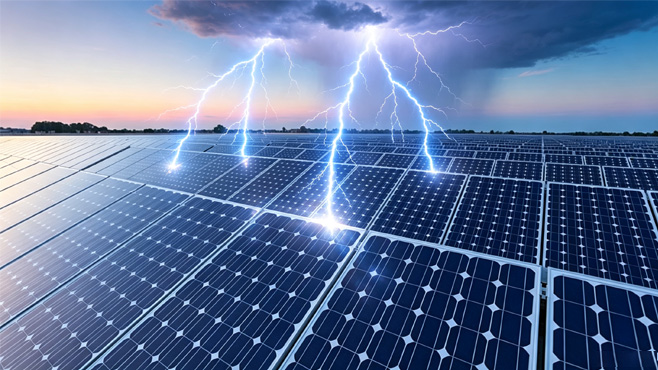
Direct lightning strikes can produce enormous amounts of energy capable of causing catastrophic damage . When lightning strikes a solar panel array, it causes an induced transient current within the system’s wire loops. This leads to the failure of the insulation, panels, inverter, and communication equipment .
Indirect Lightning Effects
Indirect lightning effects are often more common and can be equally problematic . Overvoltages can impact a solar panel system installation in several ways:
• From direct strikes to the external lightning protection system of a structure, near it, and even to the PV installation itself
• From lightning-induced currents distributed into the electrical network
• From overvoltages transmitted from the electrical network of atmospheric origin (lightning) or due to operations
• From variations of the electric field due to lightning
• From the grid, if lightning hits medium or low voltage conductors
• From the earth, if lightning hits close to the PV’s inverter
• From the DC side, if lightning hits the PV modules
Damage to Key Components
If a solar PV plant experiences a surge and is not protected with lightning or surge arresters, it can suffer equipment damage ranging from lightning burning holes in the panels to degradation of modules and inverters, or secondary systems such as monitoring equipment and tracker controls.
Specific components with the highest chances of failure include the combiner box and MPPT (maximum power point tracker device) . Some solar PV systems might withstand physical or circuit damage to their panels. However, their circuit controls and energy storage devices will be instantly unusable after a lightning strike .
Hidden Long-Term Effects
Even if there are no initial power outages, the installation can still suffer secondary effects from equipment damages. These can reduce the amount of power the system can generate. These effects are sometimes mistakenly attributed to equipment failures or manufacturing defects if it is not immediately apparent that they were caused by a surge.
If a PV module is damaged, it results in loss of power output from a string. Damage to an inverter can cut or limit output from a large section of the installation.
The Importance of Proper SPD Placement
A surge protection network should be installed throughout a solar power system’s DC and AC power distribution network to safeguard critical circuits . The overall number of SPDs needed in a solar PV system varies depending on the distance between panels and inverter .
General installation guidelines include:
• In AC lines, surge protection should be deployed on each power conductor to the ground .
• If the cable length between solar panels is under 10 meters, one SPD should be installed by the inverter, combiner boxes, or closer to the solar panels .
• In installations with DC cabling over 10 meters, more surge protectors will be needed at both the inverter and solar modules end of the cables .
• In a residential solar power system with microinverters that has short DC cabling but longer AC cables, SPDs should be installed at the combiner box to protect the home from transient surges .
SPDs should be installed on inverters to protect the DC inputs and AC outputs, with grounding on both the positive and negative DC lines. Combiner and control circuits, as well as monitoring and tracking systems, should be protected to prevent interference with electricity flows and loss of data.
4. Summary
Every solar installation should include a Solar Surge arrester. Solar systems are exposed to electrical surges from lightning strikes, grid fluctuations, and internal malfunctions.
A surge event can damage inverters, panels, combiner boxes, monitoring equipment, and energy storage devices . Damage can result in equipment replacement costs, system downtime, reduced energy production, and lost revenue .
Even if no immediate damage is visible, surges can cause hidden degradation that reduces power output over time. These effects are often mistaken for manufacturing defects.
Solar surge protection is not an option — it is a necessity . Installing SPDs on both the DC and AC sides of the system, with proper grounding, helps protect critical equipment and maintain reliable energy production .
Surge protection is a necessary component in any electrical installation, but it does not replace a proper lightning protection solution . A complete lightning protection system that includes air terminals, down conductors, surge protectors, equipotential bonding, and an earthing system is the first line of defense against a direct lightning strike .
YRO is committed to providing reliable surge protection devices for photovoltaic installations. For optimal protection, always consult local regulations, refer to manufacturer specifications, and work with certified components.
Choosing the right surge protection safeguards your solar investment. It prevents costly damage and ensures reliable, long-term energy production.