

Why Choose a 6 In 1 Out 1000V DC Iron Distribution Box?
Article Summary
A reliable DC distribution system is essential for maintaining the safety, stability, and efficiency of photovoltaic installations. A 6 In 1 Out 1000V DC Iron Distribution Box provides a centralized solution for organizing and managing multiple DC input circuits before delivering power through a single output. By integrating suitable protective and switching components into one enclosure, this type of distribution box can help simplify electrical connections, improve system organization, and support dependable operation in solar power applications.
This article explains its working principle, structural design, key components, protection functions, installation considerations, and purchasing factors. It also highlights practical questions that solar installers, electrical contractors, and project buyers should consider when selecting a DC distribution solution.
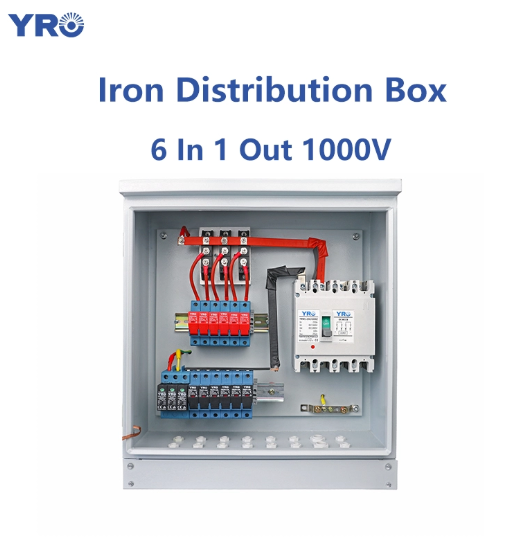
1. What Is a 6 In 1 Out 1000V DC Iron Distribution Box?
A 6 In 1 Out 1000V DC Iron Distribution Box is an electrical enclosure designed to receive power from six DC input circuits and distribute the combined electrical supply through one output circuit, subject to the internal circuit configuration and equipment specifications.
In photovoltaic systems, solar panels generate direct current (DC). Multiple strings of solar modules may need to be organized and connected before their power is delivered to downstream equipment, such as a solar inverter. A DC distribution box provides a structured connection point for managing these circuits.
The six-input configuration is particularly relevant to solar installations that require several string connections. Rather than arranging multiple separate connection points, installers can use a centralized enclosure to organize the wiring and accommodate appropriate protective devices.
Key Product Characteristics
- Input configuration: Six DC input circuits.
- Output configuration: One DC output circuit.
- Rated voltage: Up to 1000V DC, according to the product specification.
- Enclosure material: Iron construction.
- Typical application: DC circuit distribution in photovoltaic installations.
It is important to distinguish between a distribution box and an inverter. The distribution box manages electrical connections and protection, while the inverter converts DC electricity into alternating current (AC). These devices perform different functions within a solar power system.
2. Why Does a Six-Input, One-Output Design Matter?
Solar installations often contain multiple photovoltaic strings. Each string produces DC electricity, and these circuits must be connected in a way that matches the inverter's electrical requirements.
A six-input, one-output configuration offers a centralized arrangement for projects where six compatible DC input circuits need to be brought together into one outgoing circuit.
2.1 More Organized Circuit Management
When multiple strings are connected through separate devices, wiring arrangements can become complicated. A centralized distribution box helps create a more organized electrical layout, making circuit identification and inspection easier.
2.2 Simplified Installation Planning
Using a suitable multi-input enclosure can reduce the need for several independent connection points. This helps installers plan cable routing, mounting positions, and maintenance access more efficiently.
2.3 A Centralized Protection Location
Depending on the product configuration, the enclosure can accommodate protective devices such as DC fuses, circuit breakers, and surge protection devices. These components help address different electrical risks within the system.
2.4 Better Maintenance Accessibility
When the input and output connections are clearly arranged, technicians can identify connection locations more easily during inspection. Clear circuit labeling also reduces confusion when troubleshooting system faults.
However, six inputs do not automatically mean that every solar installation can use the same box. The string current, voltage, polarity, inverter requirements, and internal circuit design must all be evaluated before connection.
3. How Does the Distribution Box Work?
The basic working process involves receiving DC power from multiple input circuits, managing the electrical connections, applying appropriate protection, and delivering the resulting supply through a designated output.
Step 1: Receiving DC Power
Six input circuits are connected to the corresponding terminals inside the distribution box. Each circuit comes from a compatible photovoltaic string or another designated DC source.
Step 2: Circuit Connection and Protection
Depending on the internal configuration, the incoming circuits pass through individual protective devices or designated connection points. DC fuses or circuit breakers can help interrupt abnormal current conditions when correctly selected and installed.
Step 3: Surge Protection
If a compatible DC surge protection device is included, it helps limit transient overvoltage caused by lightning-induced surges or switching events. Its selection and grounding arrangement must match the system design.
Step 4: Delivering the Output
The connected DC circuits are routed to the designated output terminals. The output is then connected to compatible downstream equipment, commonly a photovoltaic inverter.
Typical Power Flow
Six DC Input Circuits → Input Protection and Connection → DC Distribution → One DC Output → Compatible Inverter
Note: This is a conceptual arrangement. Actual wiring topology and protective device placement depend on the specific product design and approved electrical drawings.
One critical engineering point is that connecting six photovoltaic strings in parallel requires electrical compatibility. The combined current must remain within the rated limits of the output terminals, busbars, cables, and downstream equipment. The polarity and voltage configuration must also be verified before energizing the system.
4. Essential Components and Their Functions
The overall performance of a DC distribution box depends on more than its enclosure. Internal electrical components play an important role in determining the safety, reliability, and suitability of the complete assembly.
| Component | Main Function | Buyer Consideration |
|---|---|---|
| DC Input Terminals | Connect incoming photovoltaic circuits. | Check terminal capacity, cable compatibility, and polarity marking. |
| DC Fuse Holders | Accommodate suitable overcurrent protection fuses. | Verify DC voltage and current ratings. |
| DC Circuit Breaker | Provides switching and overcurrent interruption where specified. | Confirm DC breaking capacity and pole configuration. |
| Surge Protection Device | Limits transient overvoltage. | Check Ucpv, protection level, and system grounding requirements. |
| Busbar | Provides a common electrical connection path. | Check current-carrying capacity and connection quality. |
| Iron Enclosure | Houses and protects internal electrical components. | Check corrosion resistance, finish, and ingress protection. |
| Cable Glands | Support cable entry and enclosure sealing. | Match cable diameter and installation conditions. |
Why Component Compatibility Matters
Even a well-designed enclosure cannot compensate for incorrectly selected electrical components. For example, an AC-rated protective device should not be assumed suitable for DC applications. Direct current has different interruption characteristics, so DC-specific voltage and breaking capacity ratings are essential.
Buyers should also verify whether protective devices are included as standard, offered as optional configurations, or supplied separately. This distinction helps prevent unexpected costs and specification mismatches during procurement.
5. Why Is the 1000V DC Rating Important?
The 1000V DC rating indicates that the distribution box is designed for applications within its specified DC voltage limit. This rating is particularly relevant to photovoltaic systems where the voltage of a solar string can increase under low-temperature conditions.
5.1 Supporting Higher-Voltage Solar Systems
Many photovoltaic installations use string configurations that operate at relatively high DC voltages. A distribution box rated for 1000V DC can be suitable for compatible system designs, provided the maximum calculated system voltage does not exceed the equipment rating.
5.2 Improving Equipment Compatibility
Voltage compatibility must be checked across the entire DC circuit. The distribution box, fuses, circuit breakers, surge protection devices, terminals, and cables all need appropriate ratings.
5.3 Accounting for Temperature Effects
Solar module open-circuit voltage increases as cell temperature decreases. Therefore, installers should calculate the maximum possible string voltage using the module manufacturer's temperature coefficient and the project's minimum expected temperature.
Important Selection Reminder
A 1000V DC rating is not an indication of the box's current capacity. Buyers must separately confirm rated current, maximum input current, output current, short-circuit withstand capability, and the ratings of all installed protective components.
6. What Are the Benefits of an Iron Enclosure?
The enclosure is an important part of the distribution box because it provides a physical housing for electrical components and helps protect them from environmental exposure and accidental contact.
6.1 Mechanical Strength
Iron enclosures can offer good mechanical rigidity and resistance to everyday physical impacts when properly designed. This can be useful in industrial and commercial solar installations where electrical equipment may be exposed to demanding working environments.
6.2 Structural Stability
A properly manufactured metal enclosure provides a stable mounting structure for internal components. Its design should account for the weight of the equipment, cable forces, mounting arrangements, and maintenance requirements.
6.3 Surface Treatment and Corrosion Protection
Metal enclosures require suitable surface protection to reduce the risk of corrosion. Depending on the application, manufacturers may use powder coating, painting, galvanizing, or other appropriate treatments.
6.4 Practical Customization
Iron enclosures can be designed with different dimensions, mounting arrangements, cable entry positions, and internal layouts. Such flexibility may help manufacturers adapt the product to project-specific electrical and installation requirements.
Nevertheless, iron construction alone does not guarantee weather resistance or a particular IP rating. Buyers should request verified enclosure protection specifications and confirm suitability for the intended indoor or outdoor installation environment.
7. Where Is This Distribution Box Commonly Used?
The six-input, one-output configuration is primarily relevant to DC distribution applications that require multiple compatible input circuits to be combined and routed through a centralized enclosure.
7.1 Commercial Solar Power Plants
Commercial photovoltaic projects often contain numerous solar strings arranged across rooftops, parking structures, or ground-mounted installations. A suitably configured distribution box can help organize the DC wiring and support a more structured electrical layout.
7.2 Industrial Rooftop Photovoltaic Systems
Factories and warehouses may install solar panels across large roof areas. Centralized DC distribution equipment can help simplify connections between photovoltaic arrays and downstream conversion equipment.
7.3 Distributed Solar Energy Projects
Distributed photovoltaic installations may use multiple smaller generation areas connected to designated inverter systems. The correct distribution configuration helps maintain an organized circuit arrangement.
7.4 Solar EPC Projects
Engineering, procurement, and construction contractors need electrical equipment that meets project drawings, installation standards, and procurement specifications. A multi-input distribution box can be considered when its ratings and topology match the project design.
Typical Project Users
- Solar system integrators
- Photovoltaic EPC contractors
- Electrical engineering companies
- Solar equipment distributors
- Commercial and industrial energy project developers
8. How to Choose the Right DC Distribution Box
Choosing a suitable distribution box requires more than matching the product name to a project requirement. Buyers should evaluate the complete electrical design, installation environment, protection configuration, and product documentation.
8.1 Confirm the Input and Output Configuration
Check whether the project genuinely requires six input circuits and one output. Confirm that the internal wiring arrangement supports the intended connection method and that the product drawing matches the system architecture.
8.2 Verify Voltage and Current Ratings
The maximum calculated DC system voltage must remain within the equipment's rated voltage. The combined operating current of the connected strings must also be within the permitted limits of the output path and all relevant components.
8.3 Check the Protection Configuration
Ask the supplier to specify which protection components are included. A complete technical quotation should clearly identify the fuse type, circuit breaker specifications, surge protection device parameters, and other relevant accessories.
8.4 Evaluate Enclosure Protection
For outdoor installations, enclosure protection is especially important. Buyers should confirm the IP rating, corrosion protection, sealing structure, and operating temperature range using product documentation.
8.5 Review Applicable Standards and Testing
Depending on the market and project requirements, buyers may need equipment designed and tested in accordance with applicable standards, such as IEC 61439 for low-voltage switchgear and controlgear assemblies, together with relevant photovoltaic DC requirements.
Always request valid test reports, certificates, and technical documentation applicable to the exact product configuration rather than relying only on general marketing statements.
8.6 Evaluate Supplier Manufacturing Capabilities
A dependable supplier should be able to provide clear technical specifications, wiring diagrams, component information, inspection records, and appropriate after-sales support.
| Selection Factor | Questions to Ask |
|---|---|
| Electrical Configuration | Does the internal wiring match the project requirements? |
| Voltage Rating | Is the maximum DC voltage within the rated limit? |
| Current Capacity | Can the terminals and busbars handle the calculated current? |
| Protection Devices | Which fuses, breakers, and SPDs are included? |
| Enclosure | Is the material and IP rating suitable for the environment? |
| Documentation | Are wiring diagrams and relevant test documents available? |
| Customization | Can the supplier adapt the enclosure and component layout? |
9. Installation and Maintenance Guidelines
Correct installation is essential to the reliable operation of any DC distribution assembly. Because photovoltaic DC circuits can carry hazardous voltage even when the inverter is switched off, installation and maintenance must be performed by qualified personnel following approved procedures.
Before Installation
- Review the product wiring diagram and installation instructions.
- Verify the system voltage, current, polarity, and circuit configuration.
- Check the enclosure for transportation damage or missing components.
- Confirm that the mounting surface and location are suitable.
- Prepare compatible cables, terminals, glands, and protective devices.
During Installation
- Ensure that all DC sources are isolated using approved procedures.
- Connect positive and negative conductors to the designated terminals.
- Follow the manufacturer's specified tightening torque.
- Ensure that cable entries are properly sealed.
- Complete protective earthing and bonding as required by the design.
- Verify circuit labels and wiring against the approved drawings.
Routine Maintenance
Regular inspections can help identify loose connections, damaged cables, moisture ingress, corrosion, or deteriorating protective components before they develop into more serious problems.
Maintenance frequency should be determined by the manufacturer's instructions, site conditions, and applicable electrical safety requirements. Never open or service energized DC equipment unless the procedure and equipment are specifically designed for that work and qualified personnel are authorized to perform it.
10. Purchasing Mistakes Buyers Should Avoid
Incorrect product selection can lead to installation delays, unexpected costs, and electrical compatibility issues. The following purchasing mistakes deserve particular attention.
Mistake 1: Focusing Only on the 1000V Rating
A voltage rating alone cannot determine whether a distribution box is suitable. Current capacity, short-circuit performance, protection devices, and terminal specifications are equally important.
Mistake 2: Assuming All Six Inputs Are Independently Protected
Not every six-input product uses the same internal protection arrangement. Buyers should request a wiring diagram and confirm whether individual input circuits have their own overcurrent protection.
Mistake 3: Ignoring the Output Current Limit
When several strings are connected in parallel, the output current may be significantly higher than the current of an individual input. The output terminals, busbars, and cables must be appropriately rated.
Mistake 4: Overlooking Environmental Conditions
An enclosure suitable for a protected indoor electrical room may not be appropriate for direct outdoor exposure. IP rating, corrosion resistance, temperature, and installation location must be considered together.
Mistake 5: Choosing a Supplier Without Technical Support
Electrical distribution products require accurate specifications and documentation. A supplier that cannot provide wiring diagrams, component details, or configuration confirmation may create unnecessary project risks.
11. Frequently Asked Questions
Q1: What does 6 In 1 Out mean in a DC distribution box?
It generally describes a configuration with six DC input circuits and one DC output circuit. The exact internal connection and protection arrangement should be confirmed through the manufacturer's wiring diagram.
Q2: What is the main application of a 1000V DC distribution box?
It is commonly used in photovoltaic DC systems to organize multiple input circuits and provide a centralized connection point before downstream equipment, such as a solar inverter.
Q3: Does a 1000V DC rating mean the box can handle any current?
No. Voltage and current are separate electrical ratings. Buyers must verify the rated current, maximum input current, output current, and the ratings of all internal components.
Q4: Why are DC fuses important in photovoltaic distribution boxes?
DC fuses provide overcurrent protection when correctly selected for the circuit. They can help protect photovoltaic strings and conductors against certain fault conditions. Their ratings must match the module and system design.
Q5: Is a surge protection device necessary?
Surge protection is an important consideration in photovoltaic system design. The need, type, location, and rating of an SPD should be determined according to the installation's lightning risk, grounding arrangement, and applicable standards.
Q6: What are the advantages of an iron distribution box?
An iron enclosure can provide good mechanical strength, structural stability, and flexible fabrication options. Suitable surface treatment and enclosure sealing are necessary to achieve the required environmental protection.
Q7: Can the distribution box be installed outdoors?
Outdoor use depends on the enclosure's verified IP rating, corrosion protection, temperature range, cable entry design, and installation instructions. An iron enclosure alone does not guarantee outdoor suitability.
Q8: Can manufacturers customize a six-input DC distribution box?
Customization may include enclosure dimensions, cable entry positions, internal component arrangements, terminals, and labeling. Buyers should provide electrical drawings and project requirements for technical evaluation.
Q9: What documents should buyers request before purchasing?
Useful documents include technical datasheets, wiring diagrams, component specifications, installation instructions, applicable test reports, and relevant certificates for the exact product configuration.
Q10: How should buyers determine whether a six-input model is suitable for their solar project?
Compare the number of input strings, maximum calculated DC voltage, combined output current, inverter requirements, protective device ratings, and installation environment. A qualified electrical engineer should verify the complete design before procurement and installation.
12. Final Thoughts: Building a More Reliable DC Distribution System
A 6 In 1 Out 1000V DC Iron Distribution Box can provide a practical solution for photovoltaic projects that need to organize six compatible DC input circuits into one designated output. Its value lies in the combination of appropriate electrical configuration, reliable protective components, suitable enclosure construction, and correct installation.
For project buyers, selecting the right product means looking beyond the input and output count. Voltage and current ratings, internal wiring topology, protective device specifications, enclosure protection, manufacturing quality, and technical documentation should all be carefully evaluated.
ZHEJIANG YRO NEW ENERGY CO.,LTD. focuses on providing electrical distribution solutions for new energy applications. When evaluating a DC distribution box, working with a supplier that can clearly communicate product specifications and technical configuration helps buyers make more informed procurement decisions.
Looking for a Reliable DC Distribution Box Supplier?
Are you sourcing a 6 In 1 Out 1000V DC Iron Distribution Box for a photovoltaic project? Contact ZHEJIANG YRO NEW ENERGY CO.,LTD. to discuss your technical requirements, product configuration, and customization needs.
Share your project specifications with our team and let us help you identify a suitable DC distribution solution.
Contact UsToday