

Why Are Low-Voltage Fuse Manufacturers with CB Certification More Trusted by Global Buyers?
In the global electrical product procurement market, fuses are a widely used type of circuit protection component, used in distribution systems, electrical equipment, industrial control equipment, and solar systems, among other fields.
In recent years, more and more international buyers have begun to pay attention to whether suppliers have certifications. Compared with simply checking product parameters, certifications can help buyers more intuitively understand whether the products have undergone standard tests and can also reduce uncertainties in the cross-border procurement process.
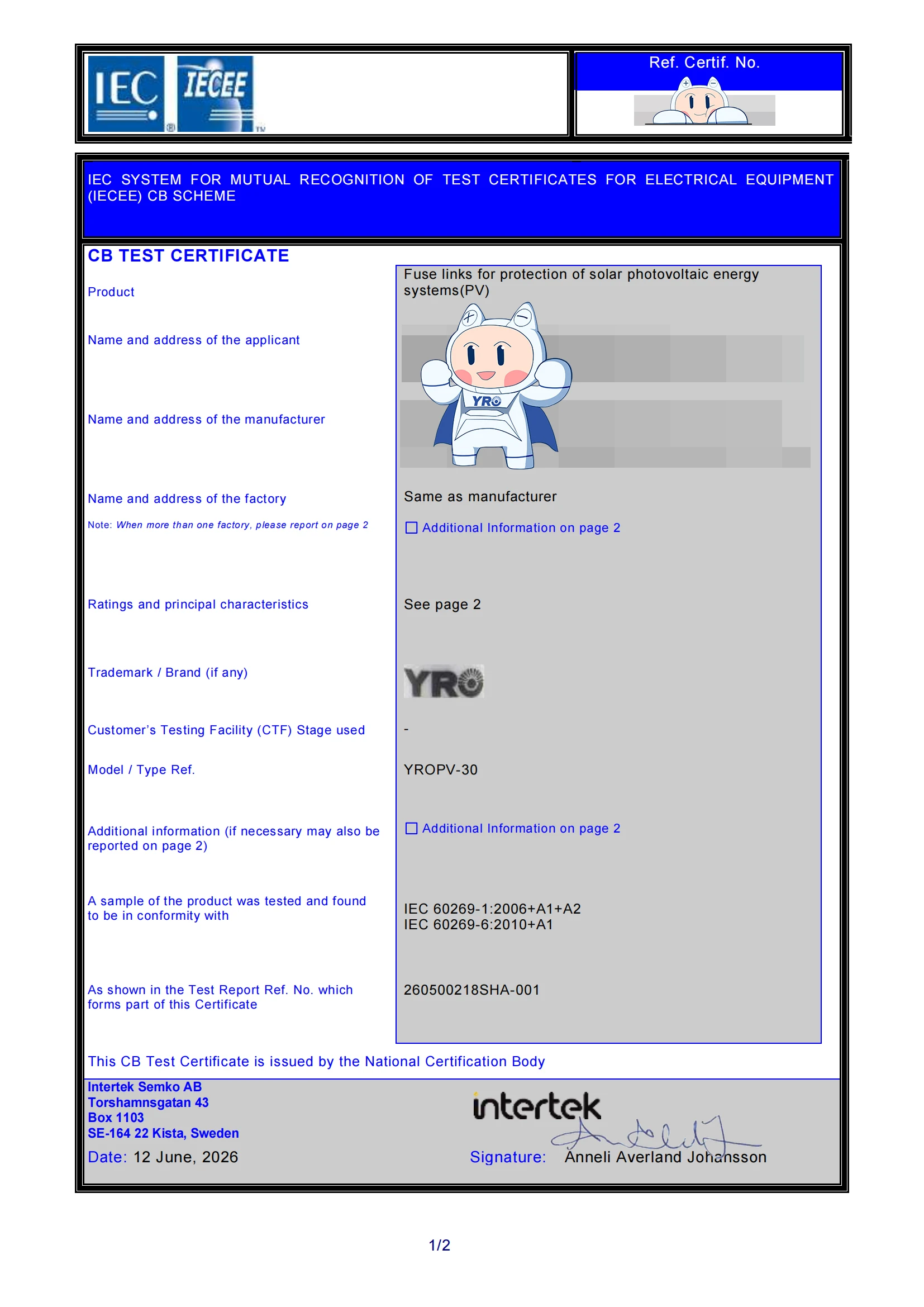
Recently, YRO's low-voltage fuse products obtained CB certification, which means that YRO has further improved its product standard compliance. This provides more options for global customers to purchase low-voltage fuses that meet international requirements.
What Is CB Certification for Low-Voltage Fuses?
CB certification is one of the important certification mechanisms under the International Electrotechnical Commission (IEC) system. The main function of this certification system is to use unified testing standards so that certification bodies in different countries and regions can recognize test results, thereby helping electrical products enter international markets more conveniently.
For low-voltage fuses, CB certification typically involves testing of product safety performance, electrical performance, and compliance with relevant standard requirements.
Simply put, CB certification helps buyers confirm:
- Whether the product has been tested according to international standards;
- Whether the product design meets relevant safety requirements;
- Whether the manufacturer has a certain level of quality control capability.
For distributors, engineering contractors, and equipment manufacturers that need to import electrical products, certification documentation helps them evaluate suppliers more quickly and reduces communication costs in the procurement process.
Why Do Global Buyers Pay Attention to CB Certification?
1.Reduce Compliance Risks in International Procurement
When purchasing electrical products across countries and regions, purchasers usually face a problem: There are differences in standard requirements for electrical products in different countries and regions.
If the product lacks relevant certification support, purchasers may need to spend more time confirming whether the product meets the requirements of the local market. For example:
- When importing electrical products, relevant test documents need to be provided;
- When distributors sell products, they need to prove the reliability of the products to customers;
- When conducting engineering procurement, project requirements need to be met.
Therefore, choosing a fuse base supplier with CB certification can help purchasers complete product evaluation more conveniently.
Certification does not mean that all market requirements are exactly the same, but it can serve as an important reference for determining whether a product complies with international standards.
2. Improve Confidence in Bulk Procurement
B2B procurement places greater emphasis on long-term supply capabilities:
- Is product quality stable?
- Does each batch of goods remain consistent?
- Can the supplier continue production?
- Can they respond quickly when demand changes?
CB certification focuses not only on the product itself, but also reflects the manufacturer's attention to product design, production processes, and quality management.
For importers and wholesalers, cooperating with fuse base manufacturers that have certification capabilities can reduce long-term procurement risks.
3. Better Suited for International Market Sales
As the global electrical market continues to develop, more and more purchasing companies in various countries and regions are beginning to pay attention to international certifications.
In particular, in Europe, Asia, and markets with rapid development of new energy, purchasing companies usually prioritize suppliers with certification materials.
CB-certified solar fuse products can help suppliers:
- Improve the completeness of product information;
- Facilitate technical reviews by customers;
- Enhance the competitiveness of overseas market promotion.
For distributors who wish to expand into the international market, certification documents are also an important part of the supplier's strength.
YRO DC Fuses Obtain CB Certification, Providing Global Customers with More Reliable Options
In order to meet the international market demand for standardization and compliance of electrical products, YRO continues to improve its product quality management capabilities.
Recently, YRO's DC fuses obtained CB certification.
This certification represents that YRO products have passed relevant standard tests, and further improves the product certification system.
As a manufacturer focused on the research, development, and production of electrical protection products, YRO not only provides industrial fuses, but also covers multiple electrical protection product areas, including:
- Fuse bases and fuse links;
- AC and DC circuit breakers;
- Surge protective devices;
- Automatic transfer switches;
- Solar combiner boxes, etc.
Through in-house production and OEM/ODM services, YRO is able to provide customers in different countries and regions with more flexible procurement solutions.
What Are the Application Scenarios for CB-Certified Fuses?
Fuses are mainly used in electrical systems that require overcurrent protection.
Common applications include:
1.Low-Voltage Power Distribution Systems
In commercial buildings, industrial facilities, and electrical cabinets, fuses can be used to protect lines and equipment.
2.Solar Systems
Electrical equipment in solar systems requires reliable protection measures.
Solar fuses can provide overcurrent protection for relevant lines according to system design requirements.
3.Industrial Control Equipment
Industrial equipment usually requires long-term stable operation, so there are higher requirements for the reliability and consistency of electrical protection components.
Conclusion
For global electrical product buyers, choosing a low-voltage fuse supplier is not only about comparing prices, but more importantly about evaluating product quality, certification status, production capacity, and long-term cooperation capabilities.
CB certification provides buyers with a reference standard for assessing product compliance, while the manufacturer's own production capabilities and service capabilities determine whether both parties can establish a long-term partnership.
As global market requirements for electrical product safety and standardization continue to increase, suppliers with certification systems, in-house production capabilities, and OEM service capabilities will more easily meet international procurement needs.
YRO obtaining CB certification for DC fuses is an important step in the continuous improvement of its product quality system. In the future, YRO will continue to provide global customers with electrical protection products and supply services that meet market demands.