

How to Implement Overvoltage and Undervoltage Protection in New Energy Applications?
Voltage fluctuations pose a significant risk to sensitive electrical equipment across various sectors, including the critical and growing new energy field. Implementing reliable overvoltage and undervoltage protection is crucial for safeguarding inverters, energy storage systems, and charging infrastructure, ensuring operational continuity and longevity. This article outlines the core concepts and effective solutions, highlighting the role of dedicated protectors like the YRO Adjustable over and under voltage protector.
1. What is Overvoltage and Undervoltage?
· Undervoltage is defined as a condition where the applied voltage drops to 90% of the rated voltage, or lower, for at least one minute.
· Overvoltage refers to an abnormal increase in the mains voltage beyond the safe operating limit of connected appliances.
Both conditions, if unchecked, can cause serious damage to devices not designed for such voltage swings.
2. Hazards of Overvoltage and Undervoltage
Prolonged operation undervoltage can cause equipment like motors and compressors to overheat, malfunction, or suffer premature failure. In the new energy context, this could affect critical components within solar pumping systems or battery management circuits. Symptoms include dim lighting and batteries failing to recharge properly.
Overvoltage forces electrical equipment to operate beyond its intended parameters. For sensitive electronic circuits in photovoltaic inverters or DC-DC converters, sustained overvoltage can be catastrophic, potentially exceeding the maximum voltage tolerance and resulting in permanent damage to the powered devices.
3. How to Prevent Overvoltage?
Effective overvoltage protection relies on timely detection and automatic disconnection. Key strategies include:
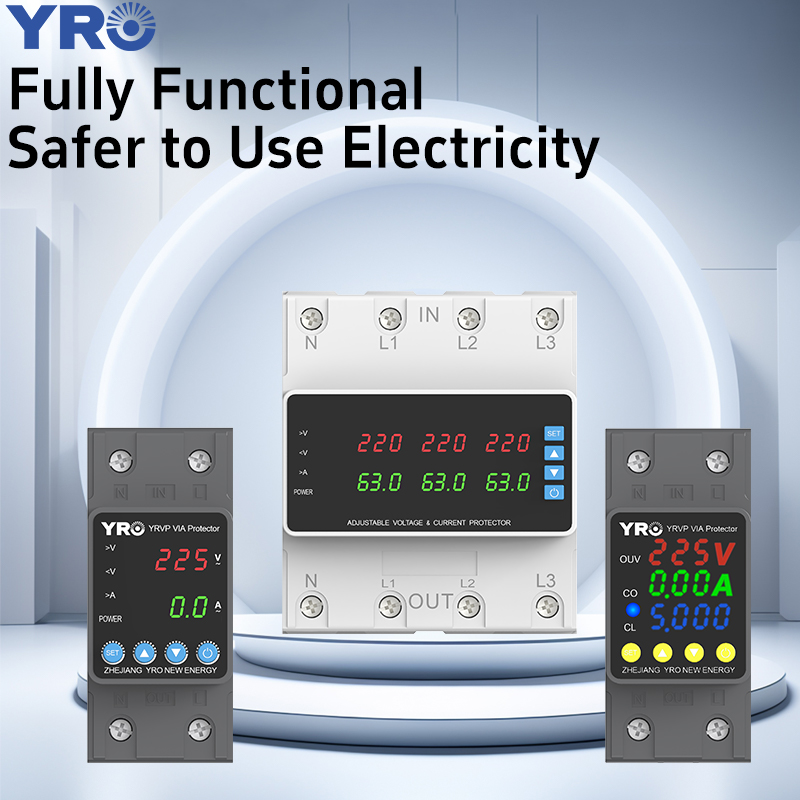
· Utilizing Dedicated Protectors: Industrial YRO Adjustable over and under voltage protector (OUPA) integrate a detection unit and an automatic switch (like a contactor). When a fault causes the voltage to rise above a set upper threshold, the protector quickly cuts off the power to the distribution line, protecting downstream new energy equipment.
· Leveraging Built-in Protections in Power Supplies: Modern switching power supplies often integrate Overvoltage Protection (OVP) functions. For instance, They can use a feedback comparator triggered within microseconds if output exceeds a set threshold (e.g., 110% of target), clamping the circuit to stop energy transfer.
· Implementing Soft-Start Circuits: To prevent output overvoltage during power-up, switching power supplies employ soft-start circuits. These allow the output voltage to rise gradually to its set value, giving the control loop time to adjust and stabilize.
· Advanced Circuit Design: For applications with rapid input voltage changes, advanced DC-DC converters use optimized control methods to prevent output overshoot and ensure a gradual, safe recovery of the output voltage, a feature valuable in new energy systems with variable power generation.
4. How to Prevent Undervoltage?
Similar to overvoltage, preventing damage from undervoltage involves monitoring and automatic intervention.
· Installing Undervoltage Relays: These devices continually monitor the supply voltage. Upon detecting an undervoltage condition (voltage below a set lower threshold), they switch off the supply to protect connected equipment. Modern relays often include an adjustable timer to prevent nuisance tripping from very short, transient voltage dips common in grid-tied new energy systems.
· Employing Adjustable Protection Circuits: Electronic protection circuits can be designed using components like adjustable shunt regulators (e.g., TL431). A voltage divider network sets a lower cut-off voltage. If the mains voltage falls, causing the sampled voltage to drop below this reference, the circuit triggers, turning off a driving relay and disconnecting the load.
5. Conclusion
Protecting valuable equipment in new energy applications from voltage instability is essential. Solutions range from simple, adjustable DIY protection circuits for specific applications to sophisticated, integrated protectors like YRO Adjustable over and under voltage protector and advanced power supply ICs. The core principle remains consistent: continuously monitor the line voltage and automatically disconnect the power when it deviates beyond safe upper and lower limits.
When selecting a protection solution like a YRO Adjustable over and under voltage protector, consider factors such as the required protection type (overvoltage, undervoltage, or both), the number of poles, installation method, and whether additional features like overcurrent protection are needed. Implementing the right protection ensures equipment longevity, safety, and reliability in demanding new energy environments.
YRO overvoltage and undervoltage protectors are designed in compliance with international standards, providing reliable protection for your electrical systems.